

For those with short attention spans, here is the short version of the story:
1. Websites that publish public school rankings utilize test scores as part of their ranking algorithm.
2. Parent income has the largest influence on test scores, not the quality of the school.
3. As a result, schools with parents that have high incomes get high scores, and schools with parents that have diverse or lower incomes get low scores.
4. We have developed a more fair and equitable public school rating system that accounts for parent income, illuminating thousands of schools nationwide that have been unfairly underrated by the current rating system.
5. Our system will uncover Out-Performers that others overlook. Happy Hunting!
For all others, read below!
School Rankings are Flawed
The ubiquitous school ratings that you see on the all the real estate search portals are biased toward schools where parents have incomes, and they unfairly underrate high-quality schools where parents have diverse or low incomes. These ratings are significantly influenced by each school’s unadjusted standardized test scores. The problem is that test scores are 70-80% attributed to parent income, not school quality.
As a result, school’s where parents have high incomes get high ratings, and the opposite is true for schools where parents have diverse or lower incomes.
Read more about how the ubiquitous ratings sites out there are misleading parents.
Many Parents Have the Same View
As a realtor, I have noticed that parents tend to have the same view when it comes to the “school score” published by greatschools, particularly when they are relocating to a new city. They want to see a 7 or better. If a school is a 6, then that feels like a D and is probably not a good school.
Parent income is not part of the conversation when people are thinking about public school rankings.
Consider a school located somewhere with a score of 7. Is that a good score? Without the context of parent income at the school, a 7 is actually meaningless. If the school is located in Kenilworth (one of the more expensive Chicago suburbs), then I’m not impressed with a 7…it should be higher. But if the school is located in the gentrifying Pilsen neighborhood in Chicago…then WOW, what is this school doing right?
Parent income drives test scores, but today’s school rating system doesn’t do a good job communicating the powerful relations ship between parental education/income and student performance. As a result, parents across the country are overlooking some schools, not realizing that low scores can simply be a reflection of socio-economic diversity.
Comparison to State Averages: Not Interesting
Greatschools.org compares a schools test score to the average test score for the entire state. In Illinois, the average for the latest scoring data available through the US Dept of Education is 37% on the reading/language arts section of the test. That’s 37% of kids are meeting or exceeding state standards on the annual standardized tests, on average. When it comes to test scores, Greatschools declares a school “good” or “worrisome” based on where the school falls in comparison with the 37% average.
We don’t like this method.
Why?
Because it ignores the single biggest influencer of test scores at a school: parent income.
Let’s start with the state average test score: 37%. The median household income in Illinois is $63,000 according to this link. Imagine a family is making twice the average household income. Is 37% an appropriate bar by which to measure performance on standardized tests for this family? Probably not. 37% is too low a bar, and as a result, many schools are being hailed as “great” when in reality, there should be some commentary about what the scores should be given the parent income at the school.
Conversely, if you make less than average household income, is 37% an appropriate bar by which to measure your child’s performance on standardized tests? Maybe not, it might be too high a bar and as a result, some schools are hailed as “bad”, not because the school quality is low, rather there is a higher percentage of children coming from lower income families.
A New Sytem For Equitable Public School Rankings
In order to achieve our goal of publishing equitable public school rankings, we had to dig into the factors that influence test scores. As it turns out, parent income is the biggest factor. Using data science, we came up with a way to rank schools by normalizing for parent income.
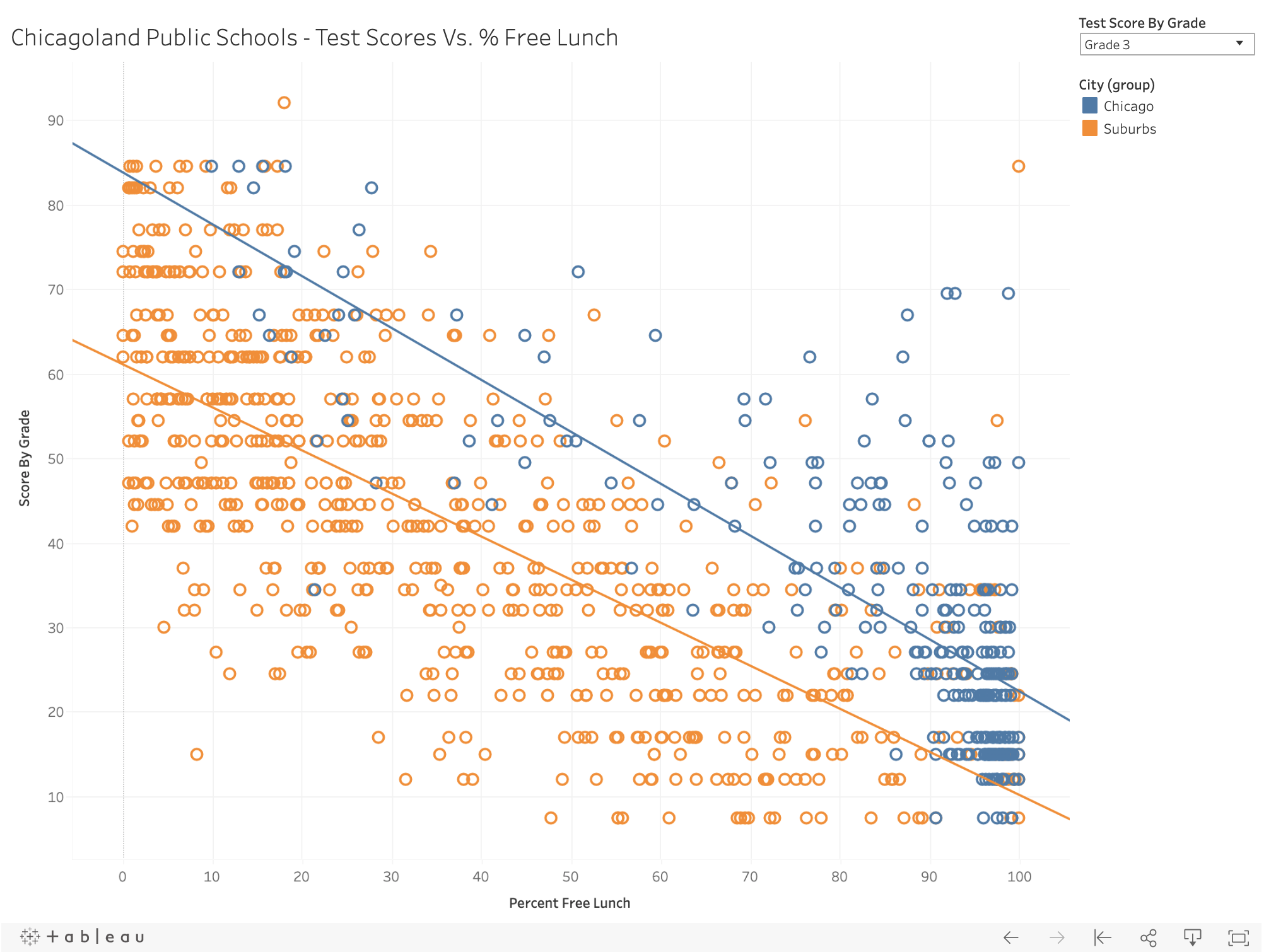
For every public school with a neighborhood boundary throughout Chicagoland, we plotted test scores against parent income (in the form of % of students that qualify for free lunch), and the results were pretty amazing.

We segmented the data by grade, so for all schools that have a 3rd grade, this graph shows the test score trend as the % of parents that qualify for free lunch increases. No surprise, as parent income falls, so do test scores.
The trend lines have an equation. The equation has something called the “R-squared”. I recall from a stats class that an “R-squared” of 0.2 means two things are probably correlated. In this graph the R-squared between % free lunch and test scores is 0.60! MOST of the reason test scores are where they are is because of parent income. But this was version 1 of our rating system, and now we are on version 2 as described below.
And in 2021, we hired a data scientist to validate (and improve) our model. Our model is now a multi-variable, non-linear regression analysis, and our algorithm is very accurate at predicting the average expected student performance scores at any parent income level. With this average score, we can more truthfully comment about the extent to which a school is impacting test scores.
Reversing a Myth
We segmented the data between City of Chicago Public Schools and Suburban Schools. Notice how the orange schools (suburban) are clustered in the upper left quadrant of the graph: high income and high test scores, while the City of Chicago schools are clustered in the lower right quadrant: low income and low test scores. This is why you hear people say “the good schools are in the suburbs”, because ON AVERAGE the suburban test scores are higher.
But when adjusted for parent-income, the City significantly outperforms the suburbs!
Notice the trend lines for the City of Chicago vs the Suburbs. At all income levels, the City of Chicago outperform suburban schools. In fact, this trend is consistent in all grade levels through highschool.
Our Ranking System
Our public school ranking system calculates the difference between the actual test scores and the expected test scores and ranks schools by this difference. In this way, we are leveling the playing field, effectively lowering the bar for schools with more disadvantaged students, while raising the bar for schools in higher income communities.
You can see the results of our public school rankings for all schools across the country at this link.
When it comes to pubic school rankings, there is no perfect system, and there is no substitute for visiting the schools in person.
Truth be told, we don’t actually think assigning one number to a school is an appropriate way to think about schools. One number can’t possibly encapsulate the students, programs, community involvement, and all the care and love that educators put forth at a school. But, the fact of the matter is there IS a ranking system out there that parents believe and rely upon. We view our public school ranking system as a step in the right direction when compared to the existing systems out there. Our public school ranking system will illuminate great schools that parents would have otherwise overlooked.
Please join our mailing list to learn how you can help in the fight to demand more equitable rankings on all the major real estate search engines.
Or you can retweet this message, or share our facebook post.
Retweet if you agree @zillow @redfin @realtordotcom @homesnap should start displaying more truthful student performance ratings, so parents can make a home purchase decision with a more balanced view of school quality.
Tweet

Our mission is to bring equitable school rankings to all families in the US, so that a home purchase decision can be made with a more balanced view of school quality. Today school rankings are biased towards privileged neighborhoods, and they unfairly discount schools with the socio-economic diversity. We aim to bring equity to school rankings.

8 Comments